
ChatGPT Apps for Real Estate Teams
A practical guide to how real-estate companies are using ChatGPT apps for property discovery, buyer and renter qualification, and conversational search that leads to a real next step.
Real-estate companies can use ChatGPT apps today, but the strongest use case is not "replace the property portal."
The clearest win is conversational property discovery: a buyer or renter describes intent in natural language, the app narrows listings fast, and the experience moves toward a shortlist, a tour, or a human handoff. That sounds simple, but it is a real shift from static filters because property search is often fuzzy. People do not always start with an exact neighborhood, price, and bedroom count. They start with something more like "a family home near water," "a three-bedroom rental in a specific part of the city," or "something modern that still feels quiet."
That direction shows up both in OpenAI's own examples and in the local app catalog on this machine. When OpenAI introduced apps in ChatGPT on October 6, 2025, it highlighted the Zillow app and quoted Zillow's Head of AI saying the app shows "the power of AI to make real estate feel more human" (OpenAI). And as of April 23, 2026, the current catalog here already includes real-estate apps like ImmoScout24, Redfin, and QuintoAndar.
If you want the broader framing first, read Use Cases of ChatGPT Apps for Business, How ChatGPT Apps Fit Into Your Business, and Should Your Business Build a ChatGPT App?.
Where real-estate companies are already using ChatGPT apps
Looking at the current app catalog plus OpenAI's own examples, four patterns show up clearly:
| Pattern | Real examples | Why it fits chat | Where it usually breaks |
|---|---|---|---|
| Conversational property discovery | ImmoScout24, Redfin, QuintoAndar, Loft | Buyers and renters naturally describe preferences in plain language | Search quality drops if the app cannot preserve trust signals like price, location, and listing context |
| Shortlist narrowing and comparison | Redfin, ImmoScout24 | Users want a smaller set of relevant options, not a giant results page | Many apps still stop at listings instead of helping the user decide |
| Market or neighborhood exploration | Scout24's conversational real-estate assistant, Zillow in OpenAI's apps launch | Users often ask exploratory questions before they are ready to search rigidly | Trust and quality matter more than novelty when location and affordability are involved |
| Lead qualification and handoff | usually custom internal builds rather than public directory apps | Chat can capture intent, constraints, and urgency earlier than a traditional form | Public app examples still show less of this than search-heavy use cases |
The pattern is consistent: chat is strongest when the user is still figuring out what they want, not when the task is already fully specified.
Property discovery is the clearest real-estate use case
This is the part of real estate that fits ChatGPT best today.
Property search starts fuzzy all the time:
- show me homes near Seattle with a modern kitchen
- find a quiet apartment in Berlin under a certain rent
- I want a house by a lake, but not too remote
- help me rent a three-bedroom apartment in Moema, Sao Paulo
That kind of intent is hard to capture with rigid filters alone.
OpenAI's own examples point in the same direction. In the apps launch post, OpenAI used Zillow as one of the flagship examples for ChatGPT apps, and in the December 17, 2025 app-submission announcement it described apps as useful for tasks like "search for an apartment" (OpenAI).
The current catalog on this machine shows how that looks in practice. ImmoScout24 can respond to a prompt like "Ich suche ein Haus am See," while Redfin handles prompts like "Show me 3 bedroom homes in Seattle with a modern kitchen."
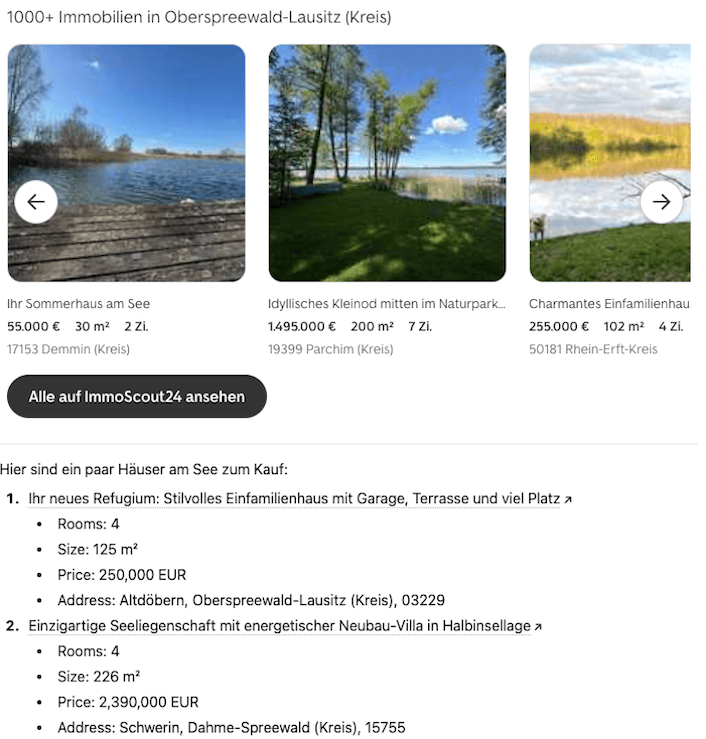
That is not just "search in chat." It is intent capture, narrowing, and visual shortlisting in one flow.
The real win is helping people narrow faster
Most property platforms are already good at inventory display.
What they are not always good at is helping a user move from a fuzzy idea to a useful shortlist without opening ten tabs, rewriting filters, or starting over repeatedly.
That is why real-estate apps in ChatGPT feel more natural than many other vertical examples. The user already thinks in narrative constraints:
- commute
- budget
- space
- neighborhood feel
- family needs
- move timing
Chat is a better front door for those inputs than a long filter form.
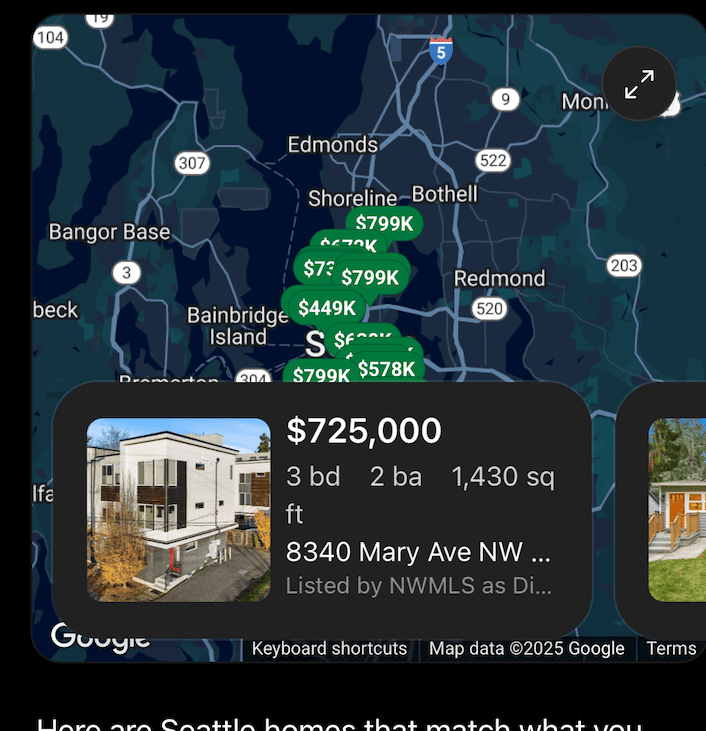
But this is also where many apps stop too early.
Search is not the final value. The harder part is helping the user answer:
- which options are actually the best fit
- what tradeoff matters most
- whether this is worth touring
- what should happen next
That is why a good real-estate app should not only return listings. It should help create momentum toward a tour request, agent handoff, or decision-ready shortlist.
Real-estate companies should think beyond public search
The obvious public use case is buyer or renter discovery, but that is not the only one.
On December 9, 2025, OpenAI published how Scout24 was building a GPT-5 powered conversational real-estate assistant and described the goal as reimagining how people discover where and how they want to live (OpenAI). That is a consumer-facing example, but the underlying lesson is broader.
The same chat-native approach can also help with:
- lead qualification before an agent sees the request
- tour-prep summaries
- buyer or renter brief generation
- property comparison for a shortlist
- follow-up recommendations after a viewing
Those workflows are often better first internal builds than a giant public "AI search" launch, because they are easier to scope and easier to measure.
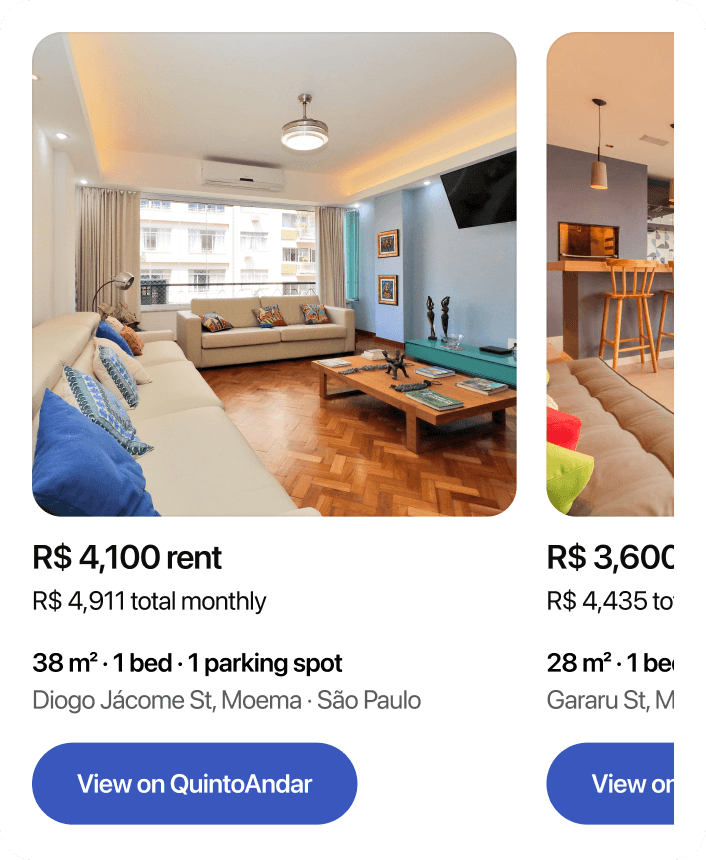
If you are building for a brokerage, marketplace, or portal, the app should usually sit at the decision layer. It should help the user clarify intent, narrow options, and move toward the next action. It does not need to replace the whole website.
If you are deciding what to build first
The wrong move is building a generic "real-estate assistant."
The better move is to choose one repeated question your users already ask in natural language. Good starting points include:
1. Buyer or renter discovery
Best for:
- portals
- marketplaces
- brokerages
- rental platforms
Why it works:
The user is describing intent, constraints, and preferences before they are ready for a rigid search experience.
2. Shortlist comparison
Best for:
- higher-consideration home searches
- cross-neighborhood evaluation
- multi-unit rental comparison
Why it works:
The app can turn scattered listing review into a compact decision surface.
3. Lead qualification before human handoff
Best for:
- brokerages
- developer sales teams
- rental operations teams
Why it works:
Chat can capture urgency, price range, location constraints, and readiness more naturally than a long intake form.
4. Viewing and follow-up prep
Best for:
- agents
- leasing teams
- concierge workflows
Why it works:
The app can summarize what the user cared about, what they rejected, and what the best next options are.
What most real-estate teams get wrong
They try to replace the whole property portal
That is usually too much scope.
The first win is better discovery and better narrowing, not rebuilding every listing, mortgage, and account workflow inside chat.
They make the app conversational but not visual enough
Real estate is a highly visual category. Listings, images, maps, price, room count, and location signals matter. That is part of why building MCP tools with rich UIs matters so much here.
They stop at search results
Users still need help deciding, comparing, and moving to the next step.
If the app only returns results without helping the user narrow, trust falls fast.
They forget the human handoff
Most real-estate workflows still end with an agent, a property manager, a tour, or a formal application step. The app should preserve context so that handoff becomes easier instead of creating a dead end.
If you run a real-estate company and want to build a ChatGPT app
Start with one repeated discovery or qualification workflow, not with a full AI portal.
The best first build is usually a narrow experience that helps a buyer, renter, or lead describe what they want, narrows inventory quickly, and then hands off to a real next step like a shortlist, a tour request, or an agent handoff. In practice, that often means a lightweight MCP-backed app that reads your listings or CRM, returns structured results with strong visuals, and keeps the next action obvious.
A good first build usually looks like this:
- pick one workflow such as property discovery, shortlist comparison, or lead qualification
- connect just the systems needed for that workflow, usually listings plus one CRM or handoff surface
- design the response with images, price, location, and key constraints instead of plain text only
- define the handoff clearly, such as save shortlist, request tour, or send agent brief
- test it privately before expanding into broader consumer search
If you want the practical build path next, read Build Custom ChatGPT Tools with MCP, Should Your Business Build a ChatGPT App?, and How ChatGPT Apps Fit Into Your Business.
Summary
Real-estate companies are already using ChatGPT apps, but the strongest pattern is narrower than "AI home portal."
Right now, the clearest wins are:
- conversational property discovery
- shortlist narrowing and comparison
- lead qualification before handoff
- viewing and follow-up support
If you are building in real estate, the goal is not to replace your portal. It is to make the messy early stage of property search and qualification easier, faster, and more human.
FAQ
Are ChatGPT apps useful for real-estate teams or just for consumers?
They can be useful for both.
Consumer-facing discovery is the most visible pattern today, but the same approach also helps internal teams with lead qualification, viewing prep, shortlist comparison, and agent handoff.
Should a real-estate app replace our website filters?
Usually no.
The better role for a ChatGPT app is to sit before or beside the traditional search experience. It should help users express intent, narrow faster, and move toward the right next step rather than replace every portal workflow.
I run a real-estate company. How do I build a ChatGPT app?
Start with one repeated workflow where users already describe needs in natural language.
Good first examples are buyer discovery, renter qualification, or shortlist comparison. Connect your listing data and one handoff system, make the UI visual and structured, and optimize for getting the user to a shortlist, a tour request, or a human handoff instead of trying to build a full AI portal on day one.
What is the best first real-estate workflow to build?
Conversational property discovery is usually the cleanest starting point.
It has clear user intent, strong fit with chat, and obvious success criteria: are the results relevant, do users narrow faster, and does the workflow lead to more qualified next steps?
Do real-estate apps need rich UI inside ChatGPT?
Usually yes.
Property search is visual, comparative, and location-heavy. Images, maps, price, room count, and quick actions often matter as much as the conversational layer, which is why text-only outputs feel weak in this category.
Get the Builder Brief
Weekly tactical notes on shipping ChatGPT apps, MCP integrations, and product-led distribution.