
ChatGPT Apps for Finance Teams
A research-backed look at how finance companies are using ChatGPT apps for spend analysis, FP&A, source-linked market research, and controlled finance workflows.
Finance companies are already using ChatGPT apps. But the strong use cases are much narrower than "AI finance assistant."
The best finance apps in ChatGPT do one of two things well: they either pull internal financial system context into chat for a real operational question, or they pull trusted external financial data into chat for research and decision-making. That is the pattern that keeps showing up in the current app catalog on this machine, and it lines up with OpenAI's own guidance for finance teams. On April 10, 2026, OpenAI's ChatGPT for finance teams page focused on reporting, planning, data checks, close support, and finance communication, not on replacing finance judgment wholesale.
That distinction matters. Finance work breaks down fast when an app gives a polished answer without enough trust, permissions, or source visibility behind it. The finance apps that feel real today are the ones that stay close to a repeated workflow: vendor spend questions, plan-vs-actual analysis, KPI retrieval with source links, transcript synthesis, or controlled financial actions in a connected system.
So if you are trying to understand where ChatGPT apps actually fit in finance, the short answer is this: they work best when the user starts with a messy finance question, but still needs a structured, auditable next step. If you want the broader product framing first, read How ChatGPT Apps Fit Into Your Business, Should Your Business Build a ChatGPT App?, and Build Custom ChatGPT Tools with MCP.
Where finance companies are actually using ChatGPT apps right now
As of April 23, 2026, the local catalog on this machine has 21 apps in the FINANCE category. Not all of them are equally strong, but the winning patterns are already clear.
| Pattern | Real examples | Why it fits chat | Where it usually breaks |
|---|---|---|---|
| Spend, policy, and reimbursement questions | Brex, Ramp | Users ask messy operational questions in plain language, not dashboard syntax | Teams lose trust if permissions, reconciliation context, or action boundaries are vague |
| FP&A and variance analysis | Cube | Finance teams constantly need quick plan-vs-actual, forecast, and board-prep answers | Generic summaries are not enough without governed data and traceable logic |
| Public-markets research and benchmarking | Aiera, Daloopa, S&P Global | Analysts naturally ask for summaries, tables, comparisons, and trend explanations in conversation | The workflow stops short if the answer is pretty but not reusable or source-backed |
| Secure finance actions in connected environments | Ramp, Brex, Intuit's announced ChatGPT app experiences | Chat is a strong front end for asking, confirming, and handing off a finance task | Day-one write actions create risk unless access, review, and policy controls are obvious |
The important thing is that finance apps are not winning because "chat is nicer." They are winning when chat becomes the fastest path from a fuzzy finance question to a trusted answer.
Finance apps are splitting into two lanes
This is the strongest pattern in the catalog today.
The first lane is internal finance workflows:
- spend analysis
- reimbursements
- policy lookups
- plan-vs-actual questions
- forecast commentary
The second lane is external financial intelligence:
- transcript synthesis
- KPI retrieval
- peer benchmarking
- filing-based summaries
- market-data questions
That split is useful because these lanes have different trust requirements.
Internal finance apps have to respect employee- or admin-level permissions, expose just enough action, and avoid turning ChatGPT into a shadow finance system. External-data apps have to solve provenance: where did the number come from, what period does it cover, and can I reuse this in a memo, model, or investment discussion?
Once you see the market that way, the current finance app ecosystem makes a lot more sense.
Spend analysis and reimbursement workflows are already real
This is one of the clearest finance use cases because the data already exists inside a system like Brex or Ramp, but the questions people ask are still conversational:
- how much did we spend with Delta last year
- what is driving travel spend this quarter
- which expenses are missing receipts
- what is my remaining T&E balance
- can finance see the company-wide view while employees only see their own data
OpenAI's Ramp app page says the app lets users analyze spend trends, query transactions, vendors, and budgets, handle employee expense tasks, and work with permission-based access so employees see only their own data while finance teams and admins can review company-wide spend. Brex's own support article for ChatGPT says the app is read-only and can be used to check recent expenses, missing receipts, reimbursement payout timing, spend limits, and card views without exposing card numbers.
That is exactly the right shape for finance.
It is useful, specific, and controlled. The app is not pretending to close the books or automate accounting policy. It is reducing the time between a question and a reliable operational answer.
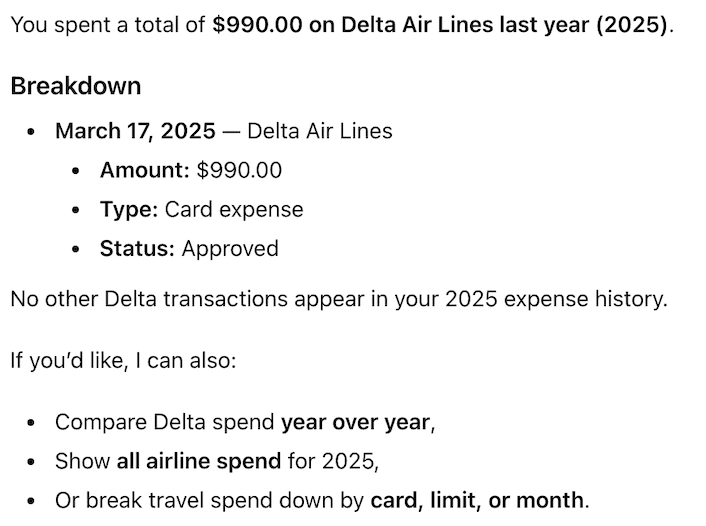
This is also a good reminder that the best finance apps do not need to be huge. A scoped app that answers spend and policy questions with the right permissions is often more valuable than a broader assistant nobody fully trusts.
FP&A is one of the strongest places to build
If ecommerce is about product discovery, finance is often about variance discovery.
FP&A teams spend a huge amount of time answering slightly different versions of the same question:
- what changed versus forecast
- which entity is off plan
- what is driving the margin miss
- what should go into the board summary
- what assumptions need to be revisited
This is why Cube stands out so much in the current app catalog.
In the local app data, Cube's ChatGPT app is clearly framed around actuals-versus-forecast questions, entity-level comparison, and role-aware access. Cube's own March 2, 2026 MCP prompt guide says its ChatGPT and Claude integrations let teams pull actuals, compare scenarios, and generate deliverables using live Cube data through MCP. Cube's broader AI for FP&A positioning is even more explicit: its platform is built around context, accuracy, control, audit trail, and role-based access for finance data.
That is the right design wedge for FP&A apps in ChatGPT.
The model is not doing freeform finance magic. It is operating on governed actuals, forecasts, and dimensional finance logic so the answer can become an input to a board deck, forecast review, or executive update.
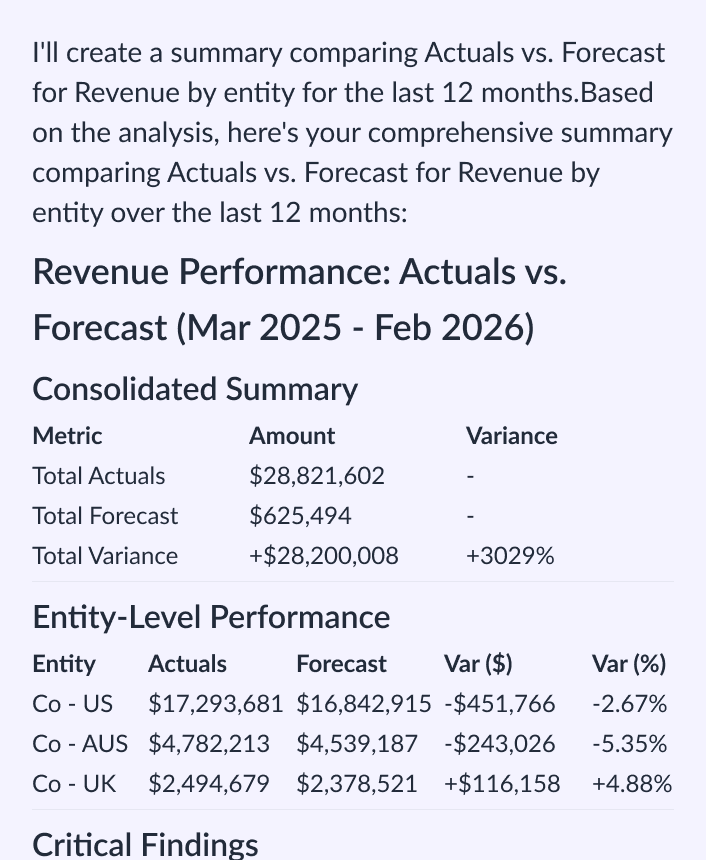
This lane matters because it is one of the most repeatable finance workflows in any company. The questions change a little every cycle, but the structure does not. That makes it a strong fit for a ChatGPT app.
Public-markets research works when the answer stays tied to sources
The other finance lane that already looks real is external research.
Here the value is not just speed. It is speed plus trust.
Analysts, investors, strategy teams, and finance leaders want answers to questions like:
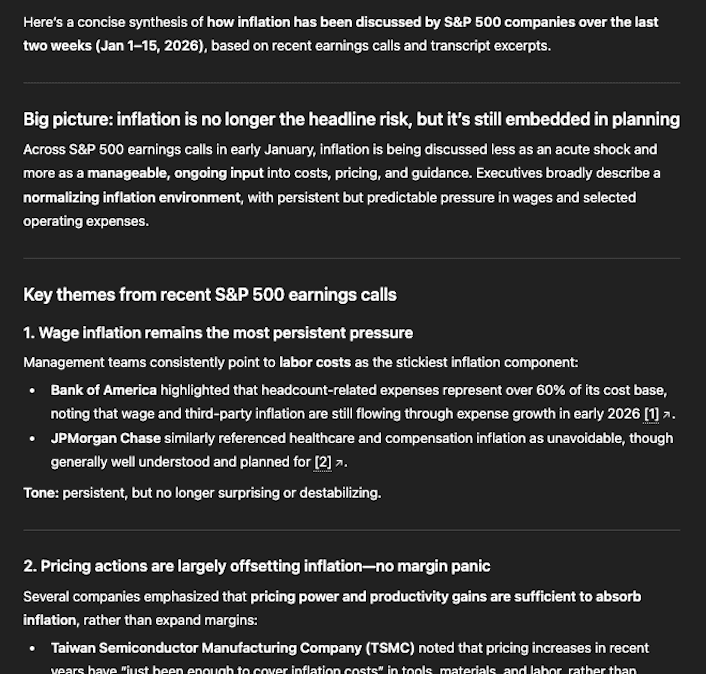
- how has inflation been discussed across recent earnings calls
- give me the last quarter financials for Microsoft in a compact table
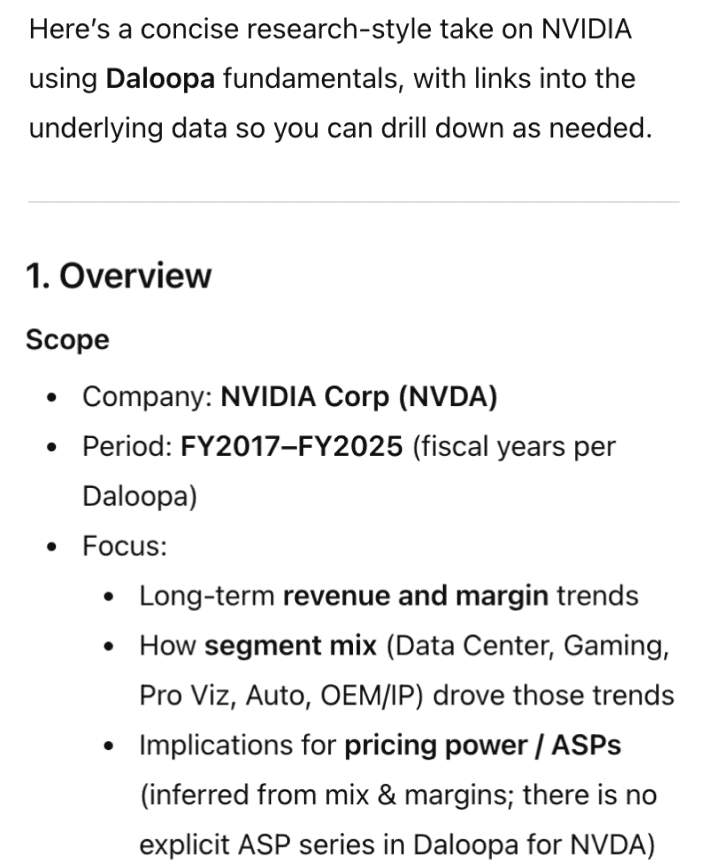
- summarize NVDA with key KPIs and source links
- compare revenue, margin, and FCF trends across peers
- pull the last four quarters of revenue and net income for a company
That is why the strongest finance research apps in the current catalog are not generic chat wrappers. They are data and research providers with a clear thesis about provenance.
Aiera is a good example. Aiera's own Core Data MCP page says its MCP server provides standardized, permissioned connectivity between AI models and enterprise-grade financial data, with conversational access to real-time earnings intelligence, company filings, and market insights. Its marketing consistently emphasizes entitlement control, inline citations, and audit trails.
Daloopa is pushing a very similar wedge from the fundamentals side. OpenAI's Daloopa app page says the app gives users verified financial fundamentals and KPIs with direct source links for analysis, benchmarking, and modeling. Daloopa's December 9, 2025 OpenAI connector announcement goes further and says each datapoint is hyperlinked back to its original source for transparency and auditability.
S&P Global's direction reinforces the same point. On February 9, 2026, S&P Global announced its app for ChatGPT, saying customers could ask complex financial questions and get answers grounded in licensed S&P Global data through a verified MCP connector, including Capital IQ Financials and earnings call transcripts (S&P Global).
So the emerging pattern is pretty clear: finance research apps in ChatGPT win when they do not ask users to trade away source confidence in exchange for conversational convenience.
What finance teams should build first
If I were choosing a first ChatGPT app for a finance company today, I would not start with a broad "finance copilot."
I would start with one of these:
1. Spend and policy analysis
Best for:
- spend platforms
- procurement-adjacent workflows
- employee finance operations
- reimbursement and policy teams
Why it works:
The question starts in natural language, but the answer depends on permissioned live data that already exists.
2. Variance analysis and board-prep support
Best for:
- FP&A platforms
- strategic finance teams
- CFO tooling
- planning systems
Why it works:
The workflow repeats constantly, and the output can be a table, summary, or commentary block that finance teams immediately reuse.
3. KPI retrieval with source links
Best for:
- market-intelligence platforms
- equity research
- investment teams
- benchmarking workflows
Why it works:
The app can compress retrieval, comparison, and provenance into one step instead of making users bounce across terminals, spreadsheets, and filing tools.
4. Read-first controlled actions
Best for:
- finance systems with strong entitlements
- workflows where the user asks first and confirms second
- products that already have clear policy and approval layers
Why it works:
Finance teams usually trust read-heavy assistance before they trust write-heavy automation.
5. Close support and reporting commentary
Best for:
- controller teams
- monthly and quarterly close workflows
- CFO reporting support
- finance communication and review cycles
Why it works:
OpenAI's finance guidance explicitly calls out reporting, planning, data checks, and finance communication as strong use cases. That makes close support a practical lane for ChatGPT apps when the app is helping assemble, explain, and standardize recurring finance outputs instead of trying to automate the entire close.
What most finance companies get wrong
They build a generic finance assistant
This sounds ambitious and usually ships as something forgettable.
The stronger question is: what exact finance question should this app answer faster than the current workflow?
They optimize for polish before provenance
In finance, a beautiful paragraph is not enough.
If the answer is not tied to the right source, period, scope, or permission model, users will often re-check it manually and the value disappears.
They add write actions too early
Brex's current ChatGPT experience being read-only is not a weakness. It is a clue. Finance teams often adopt read-heavy workflows first because they are easier to validate, safer to govern, and easier to scale.
They ignore control surfaces
OpenAI's apps guidance and apps admin documentation both point to the same things: clear permissions, minimal data access, admin controls, and compliance visibility matter. That is even more true in finance than it is in lighter business categories.
If you have a finance company and want to build a ChatGPT app
Start with one repeated finance workflow, not with your whole product.
That workflow should have all four of these traits:
- users already ask for it in plain language
- the answer depends on structured financial data
- the output can be reused immediately in the next finance step
- trust, permissions, and review can be designed clearly
In practical terms, that usually means:
- Pick one workflow such as vendor spend analysis, actuals-versus-forecast review, KPI benchmarking, or transcript synthesis.
- Expose only the tools and datasets needed for that workflow through MCP.
- Start read-first, especially if money movement, approvals, or sensitive accounting actions are involved.
- Return finance-native outputs such as compact tables, commentary blocks, benchmark snapshots, or memo-ready summaries instead of generic prose.
- Make provenance and permissions visible from day one.
- Pilot with a narrow customer set, learn where users still have to re-check the answer, and only then expand.
That last point matters. OpenAI's business apps overview says apps bring live details from business systems into ChatGPT so answers are reliable, up-to-date, and grounded in organizational data, while preserving role-based access and audit visibility. OpenAI's Help Center article on apps also says Business, Enterprise, and Edu customers do not have app-accessed information used for training by default, and that app calls are logged through compliance tooling.
So the build pattern for finance is not mysterious. It is actually pretty disciplined:
- narrow workflow
- trusted data
- clear permissions
- reusable output
- controlled rollout
If you want the implementation side next, the best follow-on reads are Build Custom ChatGPT Tools with MCP, Building MCP Tools with Rich UIs, and Should Your Business Build a ChatGPT App?.
Summary
Finance teams are already using ChatGPT apps, but the strongest examples are much more specific than "AI finance assistant."
Right now, the clearest winning patterns are:
- spend, policy, and reimbursement questions
- FP&A and variance analysis
- KPI retrieval with source links
- transcript, filing, and market-data research
- tightly controlled, permission-aware finance workflows
As of April 23, 2026, the lesson from the current catalog is straightforward: finance apps work best when they bring governed financial context into chat for one repeated question that already matters to a real team. That is where ChatGPT apps stop feeling like demos and start feeling like actual finance software.
FAQ
Are ChatGPT apps actually useful for finance teams?
Yes, when the workflow is narrow enough and the trust model is strong enough.
The best current finance apps reduce overhead around spend analysis, variance review, KPI retrieval, and research synthesis. They are most useful when they make recurring work faster without hiding the data or permission model behind the answer.
What is the best first ChatGPT app for a finance company?
Usually one of three things: spend analysis, FP&A variance analysis, or KPI retrieval with source links.
Those workflows are easier to scope, easier to evaluate, and easier to trust than a broad "finance copilot" that tries to do everything at once.
I have a finance company. How do I build a ChatGPT app?
Start with one question your customers already ask constantly, like "How much did we spend with this vendor?", "What changed versus forecast?", or "Give me the last five years of key KPIs with sources."
Then expose only the systems needed for that question, keep the first version read-first, make the answer structured enough to reuse immediately, and show where the data came from. If users still have to re-run the query in another tool to trust it, the app is not scoped tightly enough yet.
Do finance ChatGPT apps need source links, audit trails, and permissions?
Usually yes.
Finance users often care less about how elegant the answer sounds and more about whether it is grounded, reviewable, and properly scoped. The strongest finance apps in the market today are all leaning hard into permission-aware access, governed data, and transparent sourcing.
Should finance companies launch write actions in ChatGPT on day one?
Usually not.
Read-heavy workflows are a better first release because they are safer, easier to validate, and easier for customers to adopt. Once the team trusts the retrieval quality, response format, and permission model, it becomes much more realistic to add controlled actions and approvals.
Get the Builder Brief
Weekly tactical notes on shipping ChatGPT apps, MCP integrations, and product-led distribution.